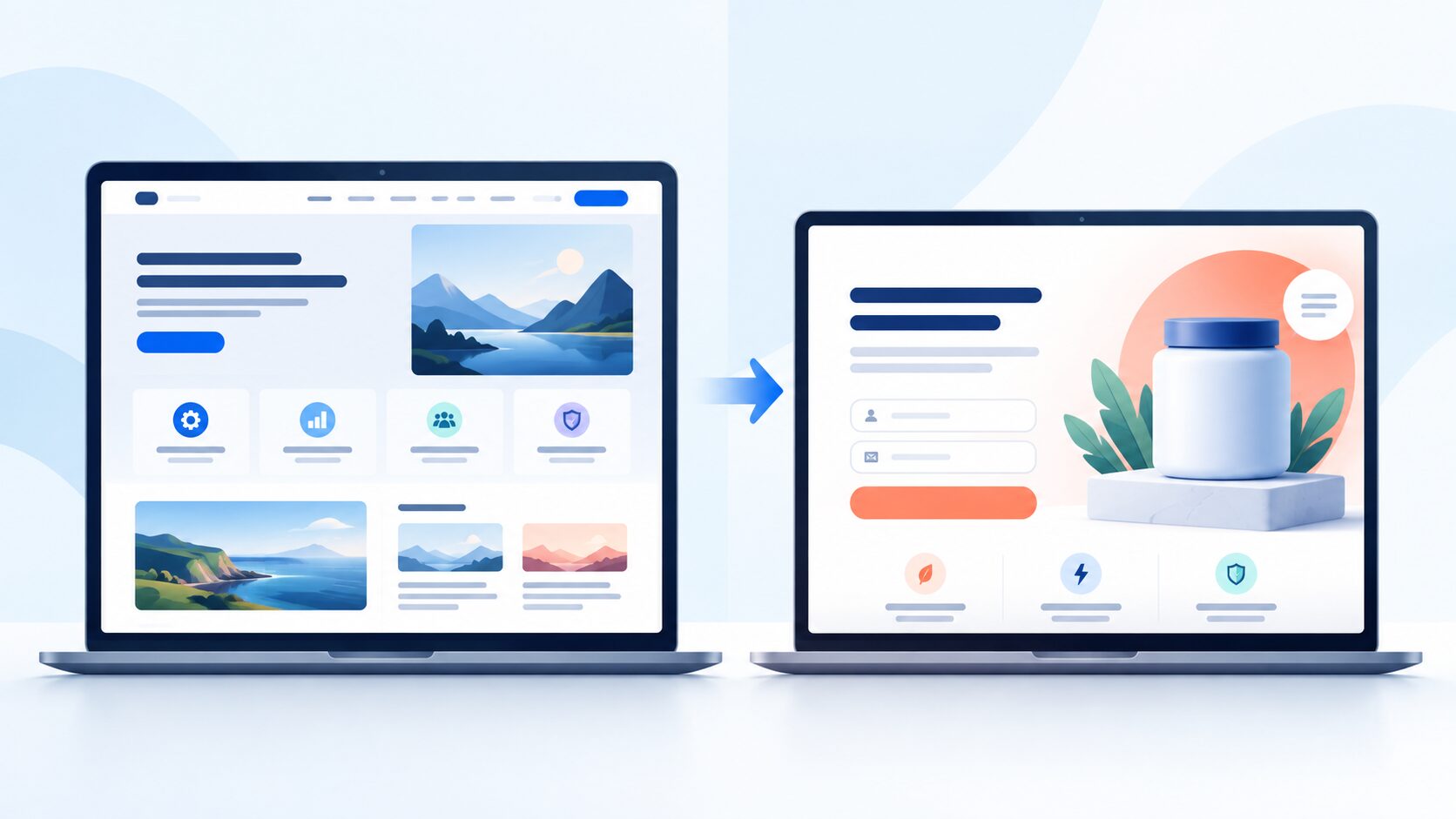
If you are building an online presence, you may be wondering whether you need a complete website or just a landing page. The short answer is that they serve different jobs.
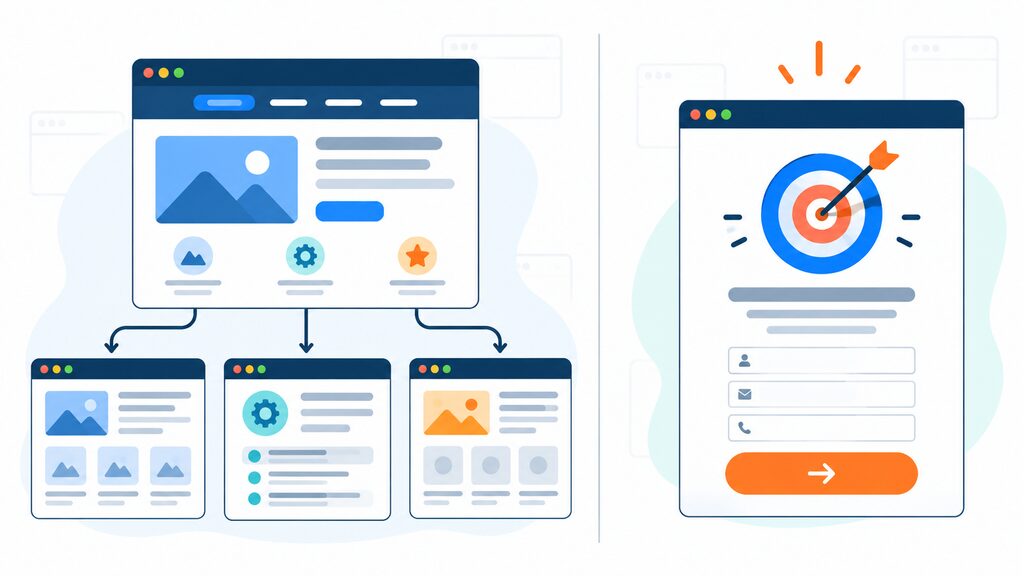
A website gives people a complete picture of your business. It can include your homepage, About page, service pages, blog, contact details, store, booking system, and customer resources. A landing page is much more focused. It is usually a single page built around one offer and one action, such as booking a call, downloading a guide, joining a waitlist, or starting a free trial.
The right choice depends on your goal, your audience, and where your visitors are coming from. In many cases, the strongest marketing setup is not a landing page or a website. It is a website supported by several focused landing pages.
Quick answer: Build a website when people need to learn about your brand, explore different pages, compare products, or find you through search. Build a landing page when you want visitors to take one specific action with as few distractions as possible.
Landing page vs website: the key differences
| Feature | Website | Landing page |
|---|---|---|
| Structure | Multiple connected pages | Usually one focused page |
| Main goal | Explain, educate, support, and grow a brand | Drive one conversion or action |
| Navigation | Full navigation menu and internal links | Limited navigation, sometimes none |
| Audience | People with broader interest in your business | A targeted audience with a specific need |
| Content | Brand story, products, services, blog, FAQs, contact details | One offer, its benefits, proof, and a call to action |
| Traffic sources | Search engines, referrals, direct visits, social media | Ads, email campaigns, social posts, and targeted search |
| SEO opportunity | Can target many related topics and search intents | Usually targets one narrow topic or offer |
| Testing | More difficult to test as one complete system | Easier to A/B test headlines, forms, offers, and CTAs |
The biggest difference is purpose. A website helps visitors understand your business. A landing page helps them decide what to do next.
What is a website?
A website is a collection of related pages published under one domain. It acts as your long-term home on the internet and gives visitors different ways to learn about, trust, and interact with your business.
A small business website may include:
- – A homepage that introduces the brand
- – An About page that explains the company and its values
- – Service or product pages
- – A blog or resource center
- – A contact page
- – FAQs, testimonials, case studies, or reviews
- – Booking, membership, ecommerce, or customer-support features
The pages are connected through navigation menus and internal links. Visitors can browse according to their own questions instead of being pushed toward one action immediately.
What is the main purpose of a website?
A website usually has several goals at once. It may help you:
- – Establish credibility
- – Explain what your business offers
- – Answer common questions
- – Appear in relevant search results
- – Let people contact, book, buy, or sign up
- – Publish helpful content over time
- – Give existing customers a place to return to
That makes a website a flexible long-term asset. It is not limited to a single campaign or offer.
What is a landing page?
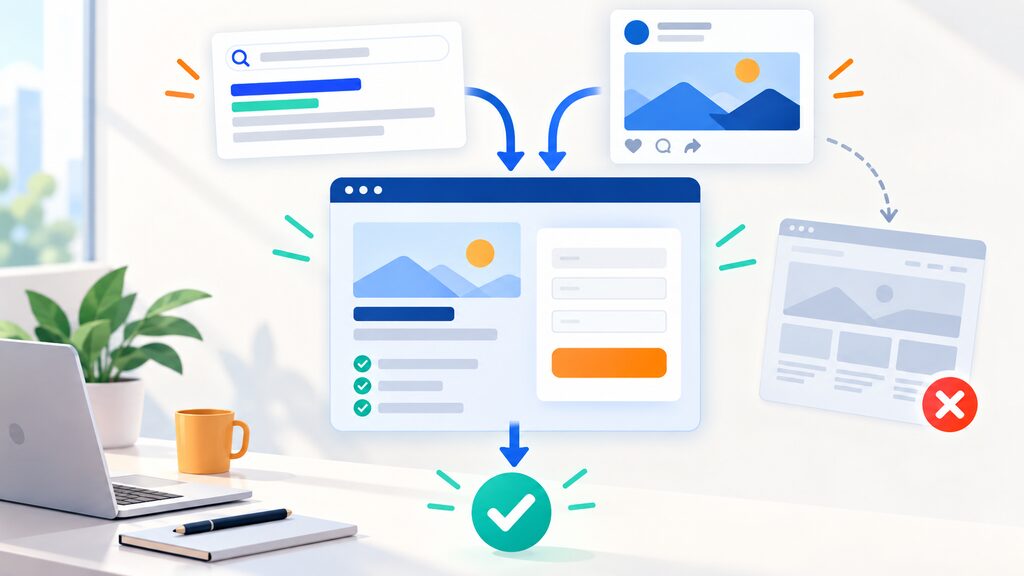
A landing page is a standalone page designed around one specific goal. In digital marketing, the visitor often “lands” on the page after clicking an ad, email link, social media post, or search result.
Instead of introducing everything your company does, the page focuses on one offer. It might promote:
- – A free ebook or checklist
- – A webinar or online event
- – A product launch
- – A free trial or demo
- – A consultation or appointment
- – A discount or limited-time sale
- – A waitlist for a new service
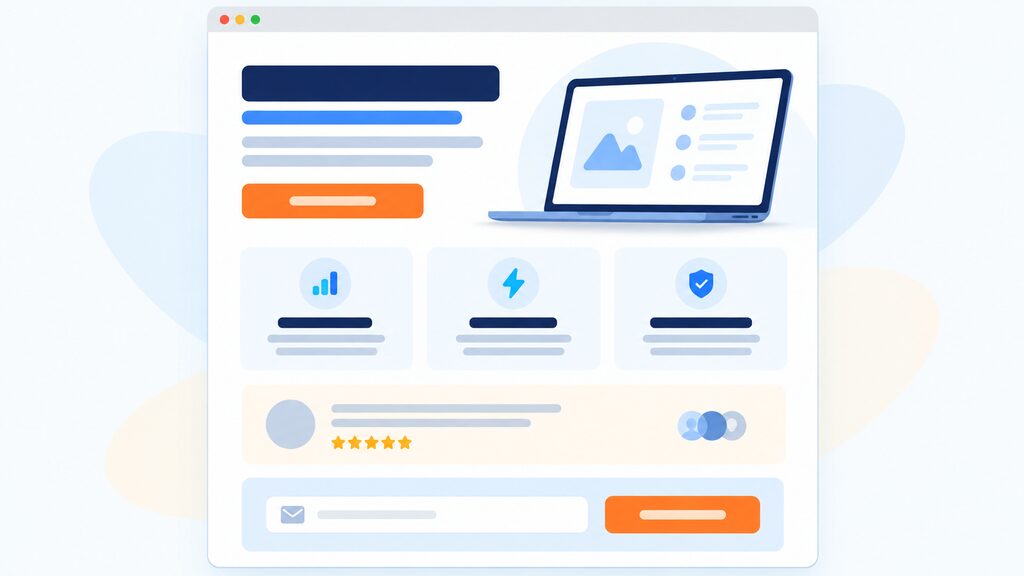
A focused landing page normally includes a clear headline, a short explanation of the value, supporting proof, and one prominent call to action. It may remove the main navigation menu so visitors are less likely to leave before completing the intended action.
What is the main purpose of a landing page?
The purpose of a landing page is conversion. That does not always mean a purchase. A conversion can be any measurable action that moves the visitor forward:
- – Submitting an email address
- – Registering for an event
- – Requesting a quote
- – Booking a call
- – Downloading a resource
- – Starting a trial
- – Completing a purchase
The page should make that action easy to understand and easy to complete.
When should you use a website?
1. You need to explain your complete business
People rarely make an important decision after seeing one sentence about a company. They may want to learn about your background, process, pricing, service area, team, guarantees, and customer results.
A website gives every important question its own place. Instead of forcing your entire brand story onto one long page, you can organize the information into a clear structure.
2. You offer several products or services
If your business offers multiple solutions, separate pages help visitors find the option that fits them. A marketing agency, for example, may need different pages for SEO, paid advertising, content writing, and web design.
This structure also creates more opportunities to explain each service clearly and target the search terms associated with it.
3. You want long-term SEO growth
A website can target a broad group of related searches through service pages, location pages, blog posts, FAQs, and educational resources. This does not mean every website automatically ranks well, but a well-organized site gives search engines more useful content to understand and users more relevant pages to discover.
Landing pages can rank too, especially when they answer a specific search intent. However, a complete website usually gives you more room to build topical depth, internal links, and authority over time.
4. Your visitors need different features
Some businesses need more than an information page. They may need:
- – Online ordering and payments
- – Product categories and customer accounts
- – Appointment scheduling
- – Member-only content
- – Forums or community features
- – Support documentation
- – Downloads and resource libraries
These functions normally require multiple pages and a broader WordPress setup.
5. You are building a recognizable brand
A website is where people can return after seeing your ad, meeting you, or hearing about your business from someone else. It gives your brand a consistent home, not just a temporary campaign destination.
When should you use a landing page?
1. You are running a paid advertising campaign
Sending paid traffic to a general homepage often creates unnecessary friction. Someone who clicks an ad for a specific course should not have to search through your homepage to find that course again.
A dedicated landing page can repeat the promise from the ad, explain the offer, answer objections, and present one clear next step.
The closer the connection between the ad and the landing page, the more consistent the visitor experience becomes.
2. You want to collect leads
Lead magnets such as ebooks, checklists, templates, and webinars work best when the signup page focuses only on the exchange: what the visitor receives and what information they need to provide.
The form should usually ask for the minimum information required. A short form with a clear benefit is often easier to complete than a long form asking for details you do not immediately need.
3. You are launching one product or offer
A landing page is useful for a product launch, early-access campaign, waitlist, or limited-time promotion. You can update the page without changing the rest of your website.
It also makes campaign reporting easier because visits and conversions are tied to one offer instead of being mixed with every other page on your site.
4. You need a temporary page
Landing-page layouts are useful for more than sales. You can create focused pages for:
- – Coming soon announcements
- – Maintenance notices
- – Custom 404 experiences
- – Login pages
- – Event registration
- – Product waitlists
These pages can communicate a clear message while keeping visitors engaged instead of showing a confusing error or empty screen.
5. You want to test an idea quickly
A landing page is easier to experiment with than an entire website. You can test different headlines, images, testimonials, form lengths, offers, and button copy.
The goal is not to change everything at once. Test one important variable, measure the result, and use the data to improve the page.
Can a landing page replace a website?
Technically, yes. A freelancer, early-stage startup, or temporary campaign may use one landing page as its entire online presence.
But a landing page usually cannot provide the same depth as a complete website. It may not give visitors enough information to trust the business, provide enough content for long-term SEO, or support features such as a blog, ecommerce catalog, customer accounts, and multiple service categories.
For most established businesses, the better setup is:
- Build a clear website that explains the brand and its main offers.
- Create separate landing pages for specific campaigns and audiences.
- Connect each campaign to the most relevant page instead of always linking to the homepage.
- Track each landing page separately so you can improve conversion rates.
Website vs landing page: which is better for SEO?
Neither format is automatically better. They support different search strategies.
A website is usually better for building a wide SEO foundation because it can target many related topics. You can create pages for products, services, locations, questions, and educational content.
A landing page is useful when the search intent is narrow. For example, a page focused on “free website audit” can be more relevant to that query than a general homepage describing an entire agency.
The important rule is to match the page to the search intent. Do not create thin landing pages simply to target slightly different keywords. Each page should offer useful, original information and a clear reason to exist.
What makes a good landing page?
A strong landing page does not need to be complicated. It needs to remove uncertainty and make the next step obvious.
Use a clear, specific headline
Tell visitors what the offer is and why it matters. Avoid vague headlines that sound attractive but do not explain the result.
Match the page to the traffic source
If the visitor clicked an ad promising a free website checklist, the landing page should immediately show that checklist. A mismatch between the ad and the page creates confusion and reduces trust.
Show benefits before unnecessary details
Explain how the offer helps the visitor. Features matter, but benefits answer the more important question: “What will this do for me?”
Add relevant proof
Testimonials, customer numbers, reviews, case studies, client logos, guarantees, and trust badges can reduce hesitation. Use proof that supports the specific offer rather than adding unrelated praise.
Keep the form short
Ask only for the information needed at that stage. You can collect more details later if the relationship develops.
Use one obvious call to action
The CTA should stand out visually and describe the action clearly. “Get the checklist” is more useful than a generic “Submit.”
Design for mobile first
Many campaign visitors will arrive on a phone. Check the page on smaller screens, make buttons easy to tap, keep forms comfortable to complete, and compress large images.
How to create a website and landing pages with PressMeGPT
PressMeGPT is useful when you want to move from an idea to a real WordPress foundation quickly. Instead of beginning with a blank canvas, you can describe your business, audience, pages, visual direction, and goals in plain language.
A practical workflow looks like this:
Step 1: Generate the main website
Describe your business and ask for the core pages you need, such as Home, About, Services, Blog, and Contact. Include your audience, tone, colors, and the action you want visitors to take.
Step 2: Refine the structure and design
Use prompts to improve the hierarchy, rewrite sections, adjust the visual direction, and add missing pages. Review the site as a complete journey, not only as a homepage.
Step 3: Create focused campaign pages
Once the main site is ready, create separate pages for lead magnets, promotions, consultations, product launches, or events. Each page should have one audience, one offer, and one primary CTA.
Step 4: Export the WordPress theme
PressMeGPT can generate exportable WordPress output for supported Gutenberg, Classic, and Elementor workflows. Choose the format that matches how you plan to edit and maintain the site after export.
Step 5: Finish the marketing setup
Connect forms, email marketing, analytics, SEO settings, payment tools, and other integrations in WordPress. Test the complete journey before sending visitors to the page.
FAQs
Is a homepage the same as a landing page?
Not always. A homepage usually introduces the broader business and sends visitors to multiple parts of the site. It can function as a landing page for a specific campaign only when it is designed around one audience and one action.
Do I need a website if I only run ads?
You can run ads to a landing page without a large website, especially when testing an offer. However, a website can improve trust, support organic discovery, and give interested visitors more information after they click your ad.
Are landing pages better for conversions?
They can be, because they reduce distractions and focus attention on one action. Conversion still depends on the offer, message, audience, trust, page speed, and user experience.
Which is cheaper: a website or a landing page?
A single landing page is usually faster and less expensive to create. A website requires more planning and content, but it provides a stronger long-term foundation for a growing business.
Can I create both with WordPress?
Yes. WordPress can manage your full website and individual landing pages. The right setup depends on your theme, editor, plugins, forms, analytics, and marketing tools.
Final verdict
A website and a landing page are not competing versions of the same thing. A website is your complete online presence. A landing page is a focused conversion tool.
Use a website to build trust, explain your business, publish content, support customers, and grow through search. Use landing pages to turn targeted traffic into leads, registrations, bookings, trials, or sales.
For most businesses, the winning strategy is to build the main website first, then create focused landing pages for the campaigns that bring visitors to it. With PressMeGPT, you can use AI to generate the WordPress foundation, expand it into a multi-page site, and create focused pages for the offers that matter most.